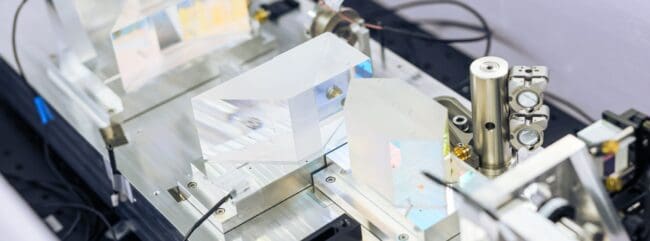

Measuring the invisible: VSL’s Picodrift interferometer is pushing the limits of precision
This level of ultra-precision measurement is now helping to solve critical challenges in industry and science.
The Netherlands is constructing a network capable of transmitting time with an accuracy of mere billionths of a second. Initially aimed at scientific research applications, it is anticipated that this ultra-precise timing will soon find everyday uses as well.
An article about the need for appropriate hydrogen standards
VSL explains how insulating a flowmeter can affect the flowmeter temperature measurement value and how this can affect the mass flow output.
Report on the effect of hydrogen-admixture on the accuracy of high pressure flow measurement.
A healthy indoor environment can be achieved by controlling the sources and by eliminating or limiting the release of harmful substances into the air. One way is to use materials proven to be low emitting.
In the MetClimVOC project (https://www.metclimvoc.eu/), VSL developed an innovative approach to follow the adsorption and desorption phenomena of low levels of methanol in cylinders based on the use of different methanol isotopes and a new laser spectroscopic method able to discriminate them.
Brachytherapy is an effective treatment option for many types of cancer. A newer variant, electronic brachytherapy (eBT), is increasingly used – but without a formal and traceable method to determine radiation dose.
The Federal Institute of Metrology METAS developed a Hydrogen Field Test Standard (HFTS) that can be used for field verification and calibration of hydrogen refuelling stations.